
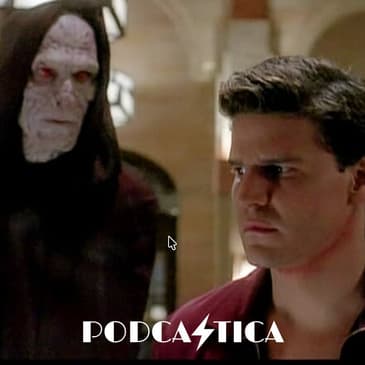





“Yep. It's not that vampires don't photograph, it's just that they don't photograph well.”
Penny, Becky and Kara enjoy a trip to 1952 to experience some grade A paranoia in an overtly political episode with a film noir flashback. The conversation ranges from HUAC to iMac laptops and tangents include transparent Y2K tech, inflatable furniture, retro fashion trends, shame, Community, Film Noir tropes, femmes fatale, earworms, New Kids on the Block, Trapper Keepers, What We Do in the Shadows, and friendship.
Next time we’ll tackle BTVS Season 5, Episode 2, “Real Me.”
Keep Slaying!
News Links/Referenced Links
Original Trailer/WB Promo: Angel “Are You Now or Have You Ever Been” Original Promo
Hollywood blacklist | History, Effect on Society, & Facts | Britannica
The Pope Has Black Roots, but Here's 15 More 'White Passing' Celebs
—----------------------------------------
Viewing Order
-
Angel 2.2: Are You Now or Have You Ever Been
-
Buffy 5.2: Real Me
-
Angel 2.3: First Impressions
-
Buffy 5.3: The Replacement
-
Angel 2.4: Untouched
-
Buffy 5.4: Out of My Mind
-
Angel 2.5: Dear Boy
-
Buffy 5.5: No Place Like Home
-
Angel 2.6: Guise Will Be Guise
-
Buffy 5.6: Family
-
Angel 2.7: Darla*
-
Buffy 5.7: Fool for Love*
-
Angel 2.8: The Shroud of Rahmon
-
Buffy 5.8: Shadow
-
Angel 2.9: The Trial
-
Buffy 5.9: Listening to Fear
-
Angel 2.10: Reunion
-
Buffy 5.10: Into the Woods
-
Angel 2.11: Redefinition
-
Buffy 5.11: Triangle
-
Angel 2.12: Blood Money
-
Buffy 5.12: Checkpoint
-
Angel 2.13: Happy Anniversary
-
Buffy 5.13: Blood Ties
-
Angel 2.14: The Thin Dead Line
-
Angel 2.15: Reprise
-
Angel 2.16: Epiphany
-
Buffy 5.14: Crush
-
Angel 2.17: Disharmony
-
Buffy 5.15: I Was Made to Love You
-
Buffy 5.16: The Body
-
Buffy 5.17: Forever
-
Angel 2.18: Dead End
-
Buffy 5.18: Intervention
-
Angel 2.19: Belonging
-
Buffy 5.19: Tough Love
-
Buffy 5.20: Spiral
-
Buffy 5.21: The Weight of the World
-
Buffy 5.22: The Gift
-
Angel 2.20: Over the Rainbow
-
Angel 2.21: Through the Looking Glass
-
Angel 2.22: There’s No Place Like Plrtz Glrb
Join the conversation! You can email or send a voice message to stillslayingfeedback@gmail.com, or join us at facebook.com/groups/podcastica and Still Slaying A Buffy-verse Podcast where we put up comment posts for each episode we cover.
Join the Zedhead community - https://www.patreon.com/jasoncabassi
Theme Music:℗ CC-BY 2020 Quesbe | Lucie G. MorillonGoopsy | Drum and Bass | Free CC-BY Music By Quesbe is licensed under a Creative Commons License.
#buffythevampireslayer #stillslaying #podcastica #angel #slaythepatriarchy
#christiankane #davidboreanaz #charismacarpenter #alexisdenisof #jaugustrichards #juliebenz
Learn more about your ad choices. Visit megaphone.fm/adchoices
[00:00:00] So klingt frische Musik. Und so klingt frische bei Aldi. Immer gut, immer günstig, immer vielfältig. Kurz gesagt, frische für alle. Zum Aldi-Preis. Diese Woche rote Tafeläpfel aus Deutschland. Zwei Kilo für nur 1,79 Euro. Oder Mini-Roma-Rispen-Tomaten 300 Gramm für nur 1,11 Euro. Entdecke viele weitere Angebote zum Aldi-Preis. Und weiter geht's mit frischer Musik für jeden Geschmack. Aldi. Gutes für alle.
[00:00:30] Hm? Aah! Sonkensger! I haven't spent any of it. Not a dime. I, I can't even bring myself to touch it. Why take it? I don't know, I was angry and I guess I just, I panicked. I mean things were going so well. I loved this job and I loved this guy. We were gonna get married and they found out about me at the bank and so they fired me.
[00:00:59] and then Peter found out why and he broke it off and I just couldn't go back to where I came from. I couldn't. So I took this and I just ran. Aren't you going to ask me why they fired me? Why'd they fire you? Because I'm not what I say I am. I've been passing since I was 15 years old. Passing?
[00:01:31] For white. My mother was colored. My father... I didn't even know him. My blood isn't pure. It's tainted. It's just blood, Judy. It's all just blood. Nobody believes that. Not even my mother's family. I'm not one thing or the other. I am nothing.
[00:02:02] I know what that's like. I am something. I've never stolen anything before in my life. I swear it. It's just... The things that they called me.
[00:02:31] Fear makes people do stupid things. It was stupid and I wish I'd never done it. I didn't mean you. I meant your former employers. They were afraid. That's why they fired you. What am I going to do? I am trapped. You're not trapped. Look, if I leave now, it'll look too suspicious. But if I stay here and the cops find this... They're not going to find it.
[00:03:25] Welcome to Still Slaying, a Buffyverse podcast. I'm Penny. And I'm Becky. And I'm Kara. For this episode, we're going to be discussing season two, episode two of Angel, titled Are You Now or Have You Ever Been? Written by Tim Minear and Mayor Smith and directed by David Simmel. This episode originally aired on October 3rd, 2000 to an audience of 3.1 million households.
[00:03:53] Some alternative titles and other languages for this episode were Haunted Hotel in Czech, The Hotel of Evil in French. Do you know about it? Have you ever been there? In Hungarian, which I love. This is my favorite though. The Paranoid Demon in Italian. I don't really think the demon was paranoid. Paranoid. Nope, but I triple checked. But I like the play on words there. I was like, did they mean paranoia?
[00:04:23] Nope, they meant paranoid. Yeah. And Shadows of the Past in Spanish. It's very poetic. I love Do You Know About It? Have You Been There? That's great. This is one of those cases where the title is a very specific reference and so it doesn't translate. I know. And these countries that went with Evil Hotel, like that's the way to go. But thank you, Hungary.
[00:04:53] Thank you. Yeah, I wonder the chances of somebody who watched this in Hungary in October of 2000 listening to this are incredibly slim. But I would love to know what they thought this episode was going to be about based on that title. And also, did people who were not American or have not studied American history at all know what this was about? Like they made it pretty obvious in the episode itself, but.
[00:05:23] I wonder. I didn't know at the time when I was watching it. Oh, yeah. As my younger self, I had no clue. I don't think I registered other than possibly being like, I learned about that, like on the TV. Yeah. But no, I'd be curious. Although I think a lot of other countries seem to be much more well versed in our ongoings and history than a lot of Americans are.
[00:05:51] Yeah, it is very true. People outside of this country are often pretty up to date on goings on in American politics. And, you know, that's because we have this army, this military and all these nuclear weapons that it makes them have motivation to keep track of us. Makes sense. We're also, you know, our number one exports are like our our content. Right. So everybody's watching our movies and TV shows and.
[00:06:20] And right now we're just a circus. So. Yeah. Tune in and watch that craziness. Yeah. It's definitely not the West Wing going on in our country right now. Not at all. At all. It is. It is the. It is the basement. But worse. Jumpster. Yeah. Did you say feet? Yeah, I said veep. Veep. But worse. I thought you said feet. I was like, I don't know what you got against feet, but I don't want to see them. Yeah.
[00:06:49] So, Becky, welcome back to the podcast. I'm so glad that scheduling worked out so you could join us for this episode. Me too. It's one of my faves. And Kara is back after a little bit of an absence from all kinds of scheduling stuff. Yay, life. Busy girls. Yeah. It's nice to be talking about something happy and entertaining. Yeah. Yeah. You've had a lot going on. Hopefully.
[00:07:14] In general, the Still Slaying team has just been incredibly occupied in the last couple of months. But it is lovely to be on with you two and to talk about this super fun episode with a little tiny film noir embedded inside of it. I thought of you. Oh, yeah. Penny's going to have a lot about this one.
[00:07:40] Well, let's start with our Y2K moment of the week. And Becky, what's yours? I wrote this down because I did not want to get it wrong. My Y2K moment is everything Cordelia. The low rise jeans, the chunky bracelet, the lower back tattoo, and the MacBook. Yep. Yeah. Yep. She encompassed Y2K. I love it. And it is a tribal style sun lower back tattoo, which is just perfect. That is so Y2K.
[00:08:11] And Charisma Carpenter, what did she say? She posted it on her Instagram and she said, this is my 90s cliche tramp stamp. Yep. Oh, so it was real. I wondered if it was really hers or if they put it on her. I wonder if she's had that lasered off by now. I wonder. I hope not. Because the Instagram post was only from a few years ago, but she was posting an old picture. Yeah. I was like, hmm. Who knows? I'm curious. That is just quintessential 90s. But yeah, her whole outfit and aesthetic.
[00:08:41] Yeah. It was glorious. Very, very Y2K. It's like the best version of it. Like she looked amazing the whole episode. Oh, her hair especially. She always does. God, the hair. Let it off. The glossy, swingy hair. So beautiful. I also zoomed in on her laptop and I had to look it up. It's a classic Mac iBook G3. Wow. The colorful clamshell. This color was called blueberry.
[00:09:07] And you can buy one online now for $300 to $400 from various like online auction sites. And one of the teal ones so bad. I remember when they hit and everybody in law school had one. And you could just like look down the row of a class and it was like all these nice bright colored pretty laptops all in a row. That's fun. It was like all at once it happened. It was pretty funny. Jeez. Yeah, I like color. Those were so cool.
[00:09:34] We have a lot of trans like parent tech in the late 90s, early 2000s. Yeah, remember those see-through phones that were like all the rage? Oh yeah. I had one of those. So ridiculous. And then I had a purple see-through phone along with my inflatable furniture and my, you know, door beads with glow in the dark stars. Oh, I never got the inflatable furniture. It was not comfortable. No. And it didn't last very long.
[00:10:03] And it would like make, if you had the bad idea to sit on it with bare skin or the wrong kind of fabric, it would make all kinds of noise every time you moved. Oh, I imagine it'd be like sitting on a pool float. Yeah. Pretty much. Yep. Yeah. We had inflatable furniture for our Barbies when I was a kid. That's kind of fun. That's cool. Little inflatable like living room set for her.
[00:10:29] And so when it came out later, like as for humans, for like full-size people, I was like, oh, Barbie had that. Was inflatable furniture a 60s or 70s thing? Because I know. Maybe. Maybe a 70s thing. That's when I had Barbies. Right. We had a lot of 70s trends come back around, I feel like, in the 90s. Yeah. Remember bell bottoms had a huge moment in the early 2000s? I remember. I was like, I want some flare jeans. And my mom was like, those are bell bottoms. That's exactly.
[00:10:59] And they're back now. They're back again. Yeah. Because the 90s are back again. So now it's like recycled, recycled style. I'm okay with it. Wild. I love the 90s. I'm a 90s girl. Me too. I just want leg warmers to come back in style. Oh, don't wait. Get some. I have four pairs of leg warmers and I love them and I wear them all the time. Do you really? Okay. I'm going to just do it. They're awesome. And I take them to the lake with me and I wear them at the lake house and they make me so happy.
[00:11:29] All right. Done. Getting leg warmers. I want my chunky Steve Madden platform sandals back. Those were my favorite, especially in like seventh grade. I felt like such a little adult. I was not. No, of course not. But you felt like it. I felt like it. Oh, geez. I want my year 2000 figure back. Well, actually, I was like, yeah, that's that would be nice.
[00:12:01] Anyway, moving on. Let's get into the episode. And I thought we should start since we already a little bit started on talking about the title and what it all means.
[00:12:12] So are you now or have you ever been is a very, very direct reference to the House Un-American Activities Committee, which was very active in the 40s and 50s as part of the overall situation in the world of the Cold War between the United States and the Soviet Union and the Red Scare going on in the U.S.
[00:12:35] And House Un-American Activities Committee, shortened to HUAC and very well known as HUAC, is famous in a lot of ways through history for like just a complete, I'm sorry, quote, witch hunt, close quotes, of people who were leftists. Anyone who might have the slightest amount of communist sympathies. And they ended up targeting Hollywood.
[00:13:00] And there were a bunch of very talented people who got blackballed and blacklisted during this period in the 50s. And this phrase, this question, are you now or have you ever been in full is are you now or have you ever been associated or a member of the Communist Party? And they would ask this of everyone. And it was sort of a famous thing.
[00:13:24] And in one of the early scenes when Angel's like just walking through the hotel lobby, a bunch of the hotel guests are sitting around the TV and they're watching the actual HUAC committee hearings in Congress. It's just wild. If people want us to not get political on the podcast, I don't know how to help them on this one. I know. It's like it is direct and intentional. Yeah. In this episode. Talk about paranoia.
[00:13:51] Speaking of the 90s coming back, like a lot of our news items when we when we do the flashback on the Buffy episodes, it's incredibly relevant to what's going on today. Right. There's like Islamophobia and also now like this beginning to sort of look for people who are like dissidents. It's starting again, in my opinion. One of my notes was how.
[00:14:15] The paranoia demon preying on people's fears and paranoia and making them do an act and think irrationally is exactly a lot of what our current administration has done and is doing today. Oh, yeah. Oh, yeah.
[00:14:37] Oh, yeah. And prejudice turns to certainty and hate. Yeah.
[00:16:03] Fear mongering. And we see that over and over and over again, whether it's race or gender or sexuality. And it's like you said, like it's impossible to bring up politics with this particular episode. Yeah.
[00:16:20] I thought it was really interesting, the role that shame played in the paranoia, because we've talked about shame a lot on this podcast, especially in relation to K-pop demon hunters. And it was also super relevant and stranger things, different podcasts.
[00:16:39] But I'm sure a lot of our viewers have or listeners have watched it is that shame and the secrets around the thing that someone is ashamed of are the entry point, the portal for evil to get in. Right. Yeah. The paranoia demon uses the shame, especially of Judy, to get inside her head and cause her to do things that are kind of out of character for her.
[00:17:03] And I mean, we don't know her very well, but I think getting a man hanged is not really who Judy thought she was as a person. Well, no. I mean, look, she sat with that for all of those years. Yeah. She spent 48 years feeling bad about it and shamed of it and keeping it a secret and staying hidden from everybody. And that just allowed this paranoia demon to feed on her, which is such a great metaphor. And and and just be content.
[00:17:33] He was so happy. He's like, I love it here. This is the best place ever. The room service is such such good service. Like, gross. But I just think it's interesting the way shame keeps coming back in different ways that we keep talking about it. And that, you know, shame in theory has like a good place in human society.
[00:17:54] Like if you do something wrong and everyone reacts and there's a bad outcome or people are mad at you about it, like a little bit of shame should stop you from doing that thing again. Can be corrective. Yeah. But when shame turns inward and secretive like this, it is corrosive. It's cancerous. It grows. And it and it allows evil.
[00:18:18] It it's a it's a portal for evil, whether that's like in a anthropomorphized like demon form or like just in motivating people to do bad things to try to feel better. And, you know, the biggest one is self-medication. Right. Like a lot of shame leads to like alcohol and drug abuse because people are self-medicating to to not feel it anymore. Yeah. But there's other ways that it expresses itself, violence and crime and just awful things.
[00:18:45] Well, and that that idea of I mean, there's at a certain part of it, there's this kind of inherent survival instinct at play almost. But I feel like that's very, you know, lizard brain to a to a certain extent. And we've evolved. We should be able to say, OK, who is motivating from or who is benefiting from this? What motivation do they have?
[00:19:09] And just like we have the parallel of McCarthyism in the 1950s in the actual hotel, that fear is being stoked, whether intentionally or unintentionally. And the panic starts to creep up. And so everyone starts to point fingers and feel like, well, if it's not you, it's going to be me. And I need to make sure that every finger is pointed away from me.
[00:19:35] And watching that happen with the guests in real time, you know, freaking out over this murder that wasn't a clear suicide that they intentionally showed us, you know, was a suicide. So we know that they're panicking, being paranoid for no reason. And the mass hysteria that mounts that kind of mob mentality is one of the most dangerous things that can happen with humans. It really is.
[00:20:04] You know, every week I tune in and it's like, oh, we're going to talk about some really intense themes on this campy vampire show that I love. Always, always. On top of that, the shame and the panic and the paranoia and all that, I really liked how they touched on Judy's, what her quote unquote shame was. Yes.
[00:20:26] Being, you know, that's a, especially back in the early 1900s, it's the early to mid 1900s before we got really into trying to abolish slavery and all of that stuff. There were a lot of men and women. If you, if you have time, listeners, go look up the, just Google people in history who passed for white and you will get a list of some extraordinary people.
[00:20:56] Drunk history has covered a few. It's been really neat. But, you know, growing up biracial, I obviously cannot pass for white. I, I, people look at me and I identify me as black, which is perfectly fine. But I liked how they brought that up. And, you know, you see it first with the family, the black family trying to check in. And the man's like, I know the sign says there's rooms, but we don't have any.
[00:21:26] And then this young lady who her life was, she was doing great. And she was quote unquote found out for the fact that, you know, she was mixed and shunned by everyone. And so it led her to do a really stupid thing. And now she's, you know, running from these people who she really, she's nothing to be embarrassed or ashamed about. I'm not quite sure where I'm trying to go with this.
[00:21:55] Other than I really liked that they touched on that. It's a surprising topic. I feel like to come in an Angel episode, you know, a show on the WB. But at the same time, they really do tackle these big topics. And that line that she said to Angel, you know, that I'm not one thing or the other. I'm nothing, nothing.
[00:22:18] Which clearly he is resonating with as being a vampire and a human, but a vampire that doesn't kill a vampire with a soul. And obviously I have no idea from personal experience, but my friends, like close friends who are mixed race talking about that struggle that you have sometimes. Do I feel like I'm a part of, you know, this side of me or this side of me?
[00:22:44] And I kind of wish they would have been able to, I don't know if this could have been a two-parter and explored it a little bit more. But it was really interesting that they put that in there too. And perfect for McCarthyism. And I was going to note too, if you are interested in that, you know, discussions touching on what it was like for people of mixed race, especially back before the civil rights movement.
[00:23:11] We did talk about it in our coverage of Sinners because it's very relevant to that movie as well. But yeah, that when the hotel, the family trying to check in, I had never clocked that before. Yeah. I didn't remember this episode very well at all. And it's funny. It's never been one of my favorite episodes. I was always like, sometimes I would skip it. I was like, eh, whatever. It's like flashback. Yeah.
[00:23:40] Angel's ashamed of his past, whatever. And I would just skip over it. And so watching it to get ready for this, I was like, I really missed out. This is a really cool episode with like a lot going on. When, Kara, earlier you were talking about the hotel guests and how they went from like normal to fearful to paranoid to like panic. And I took those conversations out and edited them all together. So I want to play it. Cool.
[00:24:10] The candle salesman in 215 shot himself. Really? Suicide? Right here in this hotel. And I heard they're not even going to report you. That's terrible. What's so terrible? Guy punched his own ticket. Why get outside parties involved? Are all screenwriters this crass? Are all actors this naive? Do you want the cops nosing around here asking questions? Or the press? Well, nothing wrong with discretion, I suppose. It's always been. So we're sitting there having a drink and the guy says to me, do they serve peanuts at this bar? So?
[00:24:38] So the guy's supposedly suicidal and he's thinking about peanuts? Maybe he's craving something salty. He doesn't get it. This wasn't a suicide. I thought they found him with the gun still in his hand and the door locked. Exactly. It's too perfect. Locked door mystery. I've written it a hundred times. You had more reason to murder him than anyone else here. What? I didn't even know the man. That's what you say. But maybe he saw you with one of your little trysts. Maybe he threatened to tell the studio. Expose, perhaps, your little peccadillos to the press.
[00:25:06] Don't you dare use alliteration with me, you hack. You're just mad because the studio won't take your phone call, comrade. Pansy. Red. And what seems to be the trouble? There's a murderer in this hotel. And we're gonna find out who. You once asked me where you could purchase a gun. That was for protection. Protection, perhaps, from a salesman who was ready to turn you in for solicitation? He shot himself, remember? Did he? Were you there? It was Consuela! She's the one that found him! Yeah, she could have found him and then shot him. I didn't say anything. Hey!
[00:25:38] Name's C. Mulvihill. P.I. He looks suspicious. I'm looking for this woman. Please stop being hurt. We're gonna do more than that, if you don't know who you are telling us everything. We know about you, heinous. Maybe registered on her as a fake. We have proof! Who knows what else she's lied about? The little slutty. I didn't mean anything, please. I'm sorry. Sorry, too. What do you have to be sorry for?
[00:26:06] What kind of maniac are you? I didn't clip the part where they hang him because it was too upsetting. Thank you. That was horrific. First of all, where'd the news come from?
[00:26:36] Anyway, why'd they have that handy? That was creepy. Just that it was like, oh, here it is. Here's the news we keep in our hotel lobby for no reason. And also the bellhop being like, hehehehe, the whole time was so upsetting. I know. It felt... I had such... A visceral reaction to that this time. I forgot it happened. And watching it, like, it made me feel kind of sick to my stomach. Because I don't think it's...
[00:27:05] You know, it's not a coincidence that the people that they're trying to scapegoat in this situation, essentially, are what we've gathered a screenwriter who is blacklisted. So probably suspected of being a commie, as he called them. And then an actor who is gay, and I'm assuming based off of Rock Hudson, who is having, you know, little flings. And it's obviously not a very tolerant era for that.
[00:27:34] And then Judy, who is a white passing woman with black heritage as well. And she points the finger to yet another outsider. It was Angel. And it's... I tried not to go all the way down the rabbit hole in this one, but it felt very intentional and heavy that those were the people who were the targets of... It's essentially a lynching. Yeah. It's exactly what it was. Yep.
[00:28:03] And I thought it was really interesting with Angel. And I didn't think about it until you were playing that clip, Penny. Angel could have easily fought off those people. Oh, no. Yeah. He totally could. He makes eye contact with Judy and then just lets it happen. Right. Because he knows he'll live through it. Yeah. I also think, you know, he...
[00:28:29] We get this 1950s Angel where he's still brooding. You know, when the guy shoots himself, he doesn't even flinch at the sound of the gunshot. He doesn't want to help Judy. He's got his soul. He's dealing with the memories that haunt him of all that he's done in his past. But he's not found his quote unquote destiny or path yet that he is supposed to be helping people.
[00:28:56] And so I almost kind of feel like him sitting there taking the beating from these people was him feeling like he deserved it. I think you're right. He also, I think at that moment, was like, this is what you get for trying to help humans. Yeah, that's true. Like, I might as well let them kill me. Yeah. Well, and it reminded me of that...
[00:29:26] What quote is it? I don't know. I know JFK said a version of it, but that line of all that is necessary for the triumph of evil is that good men do nothing. And in this situation, I mean, Angel kind of lets it happen around him and he knows he won't die. But it's a pretty good example of that.
[00:29:52] That the bellman, the hotel manager, you know, that man killed himself. You know, like they are letting this happen, essentially fed by the paranoia demon. But it's still something that feels very relevant today. And then Angel explicitly says to the demon towards the end, he's like, take them all.
[00:30:18] He literally and like directly is like, enjoy yourself, eat all these people. Like make their paranoia go completely, you know, ballistic. And that's his shame. That's why he had to go back to this hotel and had to figure out exactly what happened and had to redeem it.
[00:30:41] Such a good point that apathy and inaction can be just as damaging, if not more so, as outright evil and manipulation of a situation. And I know it's just like a can't be vampire show, but it's so good that it can elicit these kinds of conversations.
[00:31:07] And it has these themes that, unfortunately, I think will always be relevant. Yeah. It's a deeper episode than I ever gave it credit for. Agreed. I used to skip it. I think I've only seen it maybe twice. Well, I say that like I've done a big Angel rewatch.
[00:31:30] But it's always when I think about the series, it's one of the standout episodes for me. But going back and watching it as a 49 year old versus my very much younger self at the time, there's a lot I did not pick up on.
[00:31:52] And I did not realize how, I don't know, important, I guess, the messages, some of the messages were. I do want to give the bail man one like nod. It's when he goes to knock on Angel's door and he barely knocks. And that's me trying to avoid social settings and situations. I was like, that guy is me right now.
[00:32:19] Or like when you're calling someone and you're like, please go to voicemail. Please go to voicemail. Don't answer. Please don't answer. Please don't answer. Yep. Or like when you call somebody at work like at 7 p.m. Because you know they'll be on. Yeah. It's like, oh, I must have missed you. I hope this message finds you well. Sorry I missed you. Oh, man. I love that the bellhop thought Angel was creepy. I'm like, have you looked in the mirror, man?
[00:32:46] Like, you are the creepiest person I've ever seen. Do you know who that is? He looks familiar. I'm going to sing. I'm going to sing. It's terrible. Edit this out if you want to. But all we'll say is Gay Dean, Gay Dean, Gay Dean, Gay Dean. That's from Community? That guy? That's Gay Dean from Community. Oh my gosh. Oh, yes. Of course it is. He looks different.
[00:33:13] Well, I mean, I guess he's bald kind of then. He's bald in Community. Holy crap. That's so funny. He was so creepy. He really was. He really was. I thought that the acting of most of the other hotel guests was like pretty eh. And I couldn't decide if it was sort of intentionally a little stilted to seem more film noir or if they were just stilted. I kind of would back and forth on that.
[00:33:43] Yeah, I think it was intentional. It seemed kind of stylized stilted. Yeah. I will say 1950s Angel might be the most attractive angel to me. The way his little swoop, he had his hair all done and the white undershirt with a button up over it. I was like, I kind of like this version of Angel. But according to Cordelia, what does she say? It's not that vampires photograph.
[00:34:11] They just don't photograph well. Well, because in that particular picture, Angel's making a face, right? Yeah, he didn't look. It wasn't his best photo. He's mugging. It immediately made me go to the David Boreanaz bathtub photo that has been talking about many a time on this podcast. And I'm bringing it up again because nice. He is a handsome. This is well-traveled territory that he is a handsome, handsome man.
[00:34:42] Yep. Newsflash. This is brand new information. But it's so interesting to see him in a situation like we know Angel kind of loves a damsel, quote unquote, damsel in distress. He likes to help out people. And because it's a TV show, they tend to be beautiful women. And in this episode, like he does not give any Fs about Judy for the most part.
[00:35:11] Like he gets the guy away from her. Basically also because it's annoying Angel and it's interfering with his day. And then that's it. He's not. He literally closes his hotel room door in her face. It's just done. And then she approaches him at Griffith Observatory. And then and he sort of is like, uh-huh, go watch the world explode, which was hilarious.
[00:35:33] And then it isn't until the third time that they talk that he's like, all right, I'm going to help you. And he's even then he had this look on his face like, because clearly you're not going to leave me alone. Right. And he tells the dude when the guy's like, you don't want this is not something you want to get involved with. And Angel's like, you're right. I don't. You got that right. Oh, yeah. The bookstore guy.
[00:36:03] I forgot all about bookstore guy. No, no. This was the PI. He said that to the PI. Oh, the PI. The PI. You're right. I don't. But the bookstore guy was great. I love bookstore guy. Tell all your friends. When he was like, I'm going to set up my bedroll right across this door. And then Angel grabs him from behind. Oh, it made me so happy. And then when he was like, when you were turned, you were about my age, right? Just north of 30. Oh, yeah. And he was like, no.
[00:36:31] Like, are you sensitive about your age, Angel? Like a 200-year-old vampire. Okay. So funny. I had forgotten about bookstore guy. I loved his little soul patch. I loved everything about his, like, beatnik presentation. The way he actually threw the Bible at Angel. Oh, yeah. That was a good move. That was fabulous. That made me so happy. The whole thing. Everything about the bookstore. And then the fact that, like, that, you know, then they're just, like, sitting there talking and they're figuring out this ritual.
[00:37:00] And he's like, okay, well, you need these things. And he just reaches in the next shelf and he has all the ingredients needed for the ritual right there. It was so convenient. And then he grabbed the paper bag off the floor. Yes. What is happening? You can't just walk to the counter. I loved it, though. I'm like, I appreciate that. That's convenient. Save some time. I've watched so many shows for accuracy and to tell a truer story like The Pit. Yeah. To see that.
[00:37:30] It's like, this is camp. This is. And I liked it. It did not take away or detract from the episode at all. It was great. Happy. Funny. So funny. And I love that we got more gun again. Yes. Yeah. Never enough gun for me. I know. The dynamic is so much fun. He just fits in so seamlessly. Yeah. Already. Oh, I love it so much.
[00:37:57] Him and Wesley bickering and Angel thinking that it's the paranoia demon, like, getting to them and Cordelia's like, no, no, no. They've been like this since the car ride, like, on the way here. Yeah. Bickering was so cute. It was really, it was really great. Adorable. It's me. So you guys know I'm going to talk a little bit about some film noir tropes that we got in this. Heck yeah.
[00:38:18] So the flashback was all very intentionally, consciously styled like an old 40s, 50s film noir film. First of all, we have the introduction to the flashback where we get this soft focus shot, exterior shot of the hotel through a fence. And it turns it like the camera goes like through the dissolving fence into the street scene. That's a very film noir thing to do.
[00:38:48] That's like sort of a Citizen Kane kind of a thing. And then we had a bunch of stuff. The number one thing that is very, very prevalent in almost every film noir is a femme fatale. And the definition of femme fatale has morphed and changed and grown over time. And there are different kinds. There's sort of a femme fatale who's like a woman who is very dangerous. Think of like Charlize Theron in Atomic Blonde. She is an assassin.
[00:39:16] That's a fatal woman, a deadly woman. But then there's this type that is more like Judy, which is a woman who is desperate and therefore willing to do anything. But she's kind of a victim. She's not like a malicious actor. She's more of an opportunistically negligent malicious force. But she will get you killed. Like she's a dangerous woman because danger follows her. And she'll lure you in with her seeming innocence and get you killed.
[00:39:45] That kind of femme fatale is very prevalent in especially early film noir. That is the sort of formula is that she's pretty. She seems innocent. She needs help. And then it turns out either she has a secret plan all along or she turns on you or she attracts so many dangerous people to her that you end up caught in the crossfire. Different things like that happen. Another big one is cigarettes. Cigarettes were huge in film noir in the 40s and 50s.
[00:40:14] They even hate to lit one up. Yeah. Especially because in that era you couldn't have overt sexual contact on screen. It was called the Hays Code. And there were all these rules about what could and could not be on screen to get a decent rating so that you could like release your film in regular theaters. So the noir films developed this language where they would light characters with light cigarettes or light each other's cigarettes as sort of like a code for kissing and sex.
[00:40:44] That makes sense. It always feels sexual. Yeah. It's meant to. Okay. That's intentional. Film noir often deals with crime, private detectives, the general like seamy underside of society. Right? Like just the kinds of people who are staying at this hotel are all like classic film noir characters. Right? They all have a secret. They've all got something to hide. Like everybody's a little bit desperate.
[00:41:10] There's the use of like rhythmic patter, the way some of the hotel guests were talking was very noirish. There's desperation. There's always people desperate in noir movies and it drives them to commit murder or something else horrible. The fear and paranoia, huge themes in noir. The moody lighting, night shoots, dark scenes with not a lot of lighting. Shooting on location instead of on sets.
[00:41:34] Because noir films came about in large part because there was this influx of filmmaking talent from Europe during World War II. People who were fleeing World War II and the Nazis. And they came to Hollywood and they weren't part of the establishment. So they didn't have access to like the studios. But they had equipment and they wanted to make films. And they were really low budget. So they would shoot on location. And because it was hard to shoot on location in the daytime, they shot at night. They didn't have a lot of lighting equipment.
[00:42:04] So they used these very specific lighting tropes where only the subject is lit. And there's moody shadows everywhere in order to hide the low budget. And it became a style. That's cool. I did not know that. I'm just going to sit here and listen to you talk about film. Well, I only have one more thing, which is that the Griffith Observatory was very famously featured in a couple of different noir films. The most famous one being Rebel Without a Cause.
[00:42:29] And I also love that it was featured in the movie Bowfinger. And Bowfinger has like, it's a story about a group of people in Hollywood making a film. And the film that they're making is noir. And they really feature the Griffith Observatory in the film within a film and also in the film Bowfinger. So I was just excited to see it. It's a very Los Angeles, like moody, like location. That's cool. You know that was intentional.
[00:42:59] Yeah, very much so. And you know how much I love film noir and the whole aesthetic of it. And I was, I can't believe that when I saw this episode the first time, I wasn't so excited about that aspect of it. Right. I don't know what was wrong with me back then because it looked really cool. The clothes were really cool. I loved everything about it. I forgot they did great. That hooptie who song that the salesman was listening to when he killed himself.
[00:43:27] I would kill myself too if I had to listen to that. That was terrible. Them talking about maybe it was the wallpaper. Oh yeah. The wallpaper is what did it. It was hoop to who. Yeah. That would have got me too. It reminded me of hearing it and hearing it over. I had to keep rewinding that scene because my dogs were being special. But after hearing it that many times, I flashed back to that Easy Street song. Yes. That's what I was thinking of. And walking. Yeah.
[00:43:57] Oh yeah. I was like, Easy Street. I was like, Oh no. No, no, no. No. Don't do that to yourself. I know how to get a song out of your head, but it's one of those, the cure is worse than the disease things. So. Yeah. No. Because now I've immediately gone to Oh Mickey. Oh, that's a fun one. No. Okay. Until it's in your head for 47 hours. I'll be singing it when I go to sleep. It was in my head for like two years after seeing Bring It On originally. So that, that one's always back there somewhere. Yeah.
[00:44:27] It's, it's when somebody says, you ever get a song stuck in your head? I'm like, here it comes. I just hear it coming to the forefront. They rotate. It's like a Rolodex. Hopefully everyone listening to this podcast is old enough to know what a Rolodex is. Cause that would be really old. Hit us up. You know what? Those are due for a comeback. Those are going to be retro chic any day now. They're very handy. I always wanted enough contacts in one of those roller ones. Oh yeah.
[00:44:56] That was, you were a big deal. Yeah. By the time I had that kind of contacts list in my, in my business life, I, everything was digital. Like I, uh, I never had need for a Rolodex that was bigger than like six inches, like a little desktop flat one. I never had a need for one. I still have my, my filofax. That thing is my life. Cause that is how I envisioned being a grownup. When I was, I was like, I'm going to have filofax and it's going to be organized.
[00:45:26] And I am not letting that thing go. Is that like the accordion folder thing? No, it's, I mean, it's just a giant planner of giant A5. Oh, okay. It's a system. You can buy all kinds of different inserts that have different formats. So there's like calendar ones, note-taking ones, drawing. Budget's in there. Yes. I had several of those throughout my. Yeah. Uh, I wore through two filofaxes before I moved on to a different system.
[00:45:56] Like just wore them out, like broke the snap thing off and like, and then came off. I broke a lot of Trapper Keepers. Nice. Trapper Keepers. Yeah. I can hear it. The Velcro. The, yeah. Yeah. Oh man. I had a Lisa Frank one that I was obsessed with in sixth grade. I remember taking it to the first day of school. I had Dolphins. Oh, it was a big deal if you showed up first day of school with your Trapper Keepers. I had a solid color one.
[00:46:25] I thought I was so cool that I opted for not a design. I love that. And I could see that being you, Penny. That, I love that. I love that. We would have been such weird friends back in the day. We would have been. But it would have worked. You know what I mean? Yeah. That's so funny. Fast forward to my senior year of high school. I got a new kids on the block notebook because I thought it was ironic and funny. That's funny. Because I was never a fan.
[00:46:55] Oh, I was. I had, I found a photo. I will see if I can dig it up at some point and take a picture and send it to you all. I had a, I had a wall dedicated one to Jordan, one to Donnie and one to Joey. And then Danny and Jonathan split a wall because I didn't really care for those two. I was born slightly too late for new kids.
[00:47:24] My generation was very much Backstreet Boys and NSYNC. Yeah. I did love some NSYNC. I really never got into the Backstreet Boys. Nice. There's just like a couple of Backstreet Boys songs I like, but I'm a, I'm like a smidge too old for those groups. Like I, and I was a little too old for new kids on the block too. Like I was just a little too old for it, which is why I thought it was so dumb. And then why I thought it was so funny to have a new kids on the block notebook.
[00:47:54] That checks out. That makes sense. I was like, that's hilarious. Cause then people were like, what is happening? Why do you have that? And I would be like, why do you think? Not to compute. This is off brand for you. Yeah. One of these things is not like the other. Yeah. Off brand was not a phrase back then, but that's what people would have thought about that at the time. That's funny. I love it. I want a Trapper Keeper again. I do too. They're back. People are using them again. Are they really?
[00:48:19] I want like, I want to find, find one from back in the day. With like TJ Hooker on it or something. Or the 18. Have a Stranger Things Trapper Keeper. Yeah. A Stranger Things one is probably available right now. Oh my God. Look at this one. Okay. I'm stopping. Oh my God. It's a paint splatter one. Okay. All right. Okay. All right.
[00:48:44] I do want to say one more thing about the show that I liked a lot going along with your noir vibe. I loved the dual timeline. Yeah. And how, like there were moments when he was in the shop as 1952 Angel, but he was really current day or present day Angel. It was, I was like, wait a minute. I had to rewind. And like, I saw that. Right. Right. Yeah. The transitions were really close. They were so good. Yeah.
[00:49:13] There was another great one when they, when the demon in the fifties was like, when Angel was like, take them all. And the demon was like, and then they cut to the demon being like, ah, cause they were raising him. Oh, it was a perfect cut. I was like, that was so cool. The way they did that. Like just transition from those two scenes. I loved it. That was very well. I will say if there is anything about this episode that was not my favorite or took me
[00:49:42] out of it slightly, it was probably the demon's tentacles. And it just like, there was that one tentacle kind of laying there, not doing anything that was really long that Angel was able to run over. I was like, all right. All right. I was like, I will forgive it because it was, you know, it's campy. It's funny, but I was like, okay. And it gave a great line. It gave one of the great, great conversation moments between Cordy and Wesley in the episode
[00:50:12] but yeah, it was his voice. It did not fit. I was like, what is he talking? I enjoyed the demon. The tentacles aside, I liked the way that he was like slightly jolly. Like he was like, it tastes so good here. I'm so happy. Thank you for pumping her. She's great now. She's a whole tidy meal. Like she eats. Oh yeah. That was funny. Whoever that was had a blast. Yeah. And then he's like, Angel, why don't you help some of these other people?
[00:50:42] People. It's going to be great. You're like, you're like adding seasoning. You're like hot sauce. Like get it all over all these people. You know? Like, oh. He made a whole meal out of like two scenes. Like good for him. Demon guy. Yeah. And he was like, I'm good. That is true. I'm like, can I eat like that? It was making me smile. For 50 years. Yeah. I found him really enjoyable. I thought that the electrocution tentacle scene was a little ridiculous.
[00:51:11] It also occurred to me that that was planned. Like I never noticed this before the third time I watched the episode, but that when Angel says gun and gun shoots one of the tentacles, clearly they had pre-planned that gun would get his attention in one direction so that Angel could grab the tentacle and electrocute him on the power box that he had like hot wired earlier in the day. Like great job.
[00:52:03] For like 50 years. 50 additional years. And like nobody found her. Yeah. I don't. I thought that I had the same thought at the very end. Because at first I was like, is that her ghost? And I thought that like as it was happening and I was like, no, it's not a ghost. No, it's really her. I just put it to she just, I mean. Maybe it was a magic hotel tour. And the demon kept her hidden. Right.
[00:52:33] So maybe the demon was able to just keep people from going to her room. Kaffee in seiner besten Form mit der neuen Cubo One Kapselmaschine von Chibo. In jeder Cubo Kapsel steckt Spitzenkaffee aus besonderen Anbaugebieten. Für Espresso, Kaffeekremer oder Kaffeekrande auf Knopfdruck. Die neue Cubo One überzeugt mit Premium Design, kompakter Größe und kleinem Einstiegspreis ab 29 Euro. Dank innovativer Press Brew Technologie wird jede Tasse besonders aromatisch mitsamtiger Crema.
[00:53:02] Entdecke jetzt die Cubo Kapselmaschinen in deiner Chibo Fiale und auf Chibo.de.
[00:53:32] We do in the shadows named Colin Robinson. And he is an emotional vampire. He lives with the other vampires. And even the other vampires are like, ugh, Colin. That's so funny. Yeah, he's an energy vampire. He is hilarious. And what we do in the shadows is hilarious. And Becky's What's On Tonight covered it. At least the final season. The final season. Yeah, that's what made us start podcasting was we really wanted to talk about that final season of that show. Listen, I just started a rewatch of that.
[00:53:59] I need to remember to listen to you. Oh, please. Yeah, go back and listen. It's so funny. I went back and listened. We hit our year. I like it. We should cover that movie on here at some point. Well, I think. We could do a joint with what we do in the shadows. Yeah. I think that would be so fun. We did not cover it. We should do that. That would be fun. But that would be a lot of fun. All right. Chalk that up. All right. Let's get back to this episode.
[00:54:28] I had a couple of little notes. One, the demon making Wesley insecure and paranoid, which especially that one was so spot on. That was so pretty. And then Wesley being like, no one's ever said I'm paranoid unless they're saying it behind my back. That was adorable. It was very successful to do that to Wesley. The art deco and Spanish architecture in the hotel.
[00:54:53] I'm going to be annoying about this for the rest of the season, probably because I love all the little details. I love the shape of the light fixtures. I love the like, I don't know what that is. Limestone walls. It's my favorite, favorite kind of architecture. It's one of the reasons I go back to Los Angeles all the time because I just love the aesthetics of LA. It's so, so beautiful. That hotel. I think we talked about it when our last, when we did episode one.
[00:55:22] It just, it's its own beautiful, amazing character. Yeah. Yeah. I'm with you, Penny. I love everything about it. I love the way Angel looks at the hotel, right? They're like, you know, Cordelia's like, this place is creepy. And Wesley's like, this is a house of evil. And Angel's like, not anymore. And he's grinning because he has redeemed this hotel. He got rid of the evil. He closed the loop on some of his earlier shame.
[00:55:50] And it's like a little micro version of redeeming himself. Yep. Which is what he wants. Nice. And he found a home for them. And he's an extension of himself. Yeah. He's very happy about it. And like being able to give Judy that kind of release. Yeah. Was nice. I love how when she's like touching his face, she's like, you look the same. It's like, ah, yes. Yes, he does. I never did mention to you why I had that blood in my hotel room.
[00:56:20] But yeah. But his respect to her being like, I'm not. Basically making the point, I am not the same. I was like, oh, that's good. Because he is so drastically different. And now, instead of letting these things happen and being indifferent and apathetic to him, he is out there helping people. Yep.
[00:56:43] And it's really, it is really nice and poignant that, like you were saying, the hotel is now the setting. It's their headquarters to help people. It's such a good set. It's like, oh, so excited. I kept thinking about this quote, and I don't know who said it. And in my head, I think it was Robin Williams, but there's no way that's right. Just because you're paranoid doesn't mean nobody's out to get you.
[00:57:13] So the hotel guests all get more and more paranoid, right? But they are actually in danger from the paranoia demon. They are, somebody is actually out to get them, but their paranoia doesn't allow them to see that the only thing you have to fear is fear itself, right? Is that the fear is the danger. So they are pointing fingers at each other because they can't perceive the idea of a demon. But like, just because they're paranoid doesn't mean they aren't in danger. Yeah.
[00:57:41] Sometimes when people are warning about something happening in the world, people are like, oh, you were anxious. Oh, you're overwrought. Oh, you're having an emotional response. Doesn't mean they're not actually worrying about something real. Exactly. Just saying. I also love that the way that the demon operates was with whispers and innuendo. He doesn't say like, the guests are going to turn you in and you'll get shut down. He sort of is like, what's going to happen? The cops come and the concierge is like, we'll get shut down.
[00:58:10] He's like, oh, you'll get shut down. And it's whispers and innuendo. The same way paranoia spreads in society. And this shows up in every witch hunt movie and book and play. The Crucible is one of the biggest versions, like most famous versions of this about the Salem Witch Trials, which was actually a play about McCarthyism. And it's about how people will turn on each other out of fear and that gossip and rumor will just feed into the fear and make it grow.
[00:58:41] Yep. Fear will make you do crazy things. When you were playing the culmination of all of those moments where the paranoia is growing, it's interesting to hear. It's like a crescendo of voices. They start to speak faster. They're getting louder. And the soundtrack and the score in this episode, we're so good at conveying that too. And just hearing, it's like this build slowly.
[00:59:10] And it's so sinister. And that's another thing I think this show, it doesn't get talked about enough, is the sound design and the music choices. Because they're perfect, except for that one song. Yeah. Just over and over again. Well, I mean, I don't know. That song might have been perfect for what it was intending to do. I just hated it. Yeah. It was not their first choice to be playing during that scene. That's good to know.
[00:59:40] It was horrible. There's a section early in the episode from 6 minutes and 34 seconds to 8 minutes and 54 seconds where there's no real dialogue. Angel walks through the hotel lobby. The last bit of dialogue we hear is when the manager is turning away that black family. And then he goes upstairs. He walks down the hall. And he has this long, meaningful eye lock moment with the PI.
[01:00:06] Then he goes back in his room and he goes back out to the ice, get the ice bucket. Another long look with the PI. And then he sees the gay actor when he's going back to his room. And they have a long lock eyes moment. And the next dialogue we hear is from Judy when Angel finds her in his room. And first of all, I just thought that was like just cool to have like almost no dialogue. The only dialogue, it's not really dialogue.
[01:00:30] The only speaking during that time is the salesman is like mumbling to nobody in the hallway. And we hear whispers. It's the paranoia even making him crazy. Creepy. Creepy. I also thought it was super gay. Not the actor and his tryst person. But the way that Angel and these men were locking eyes at each other in this dark moody hallway. I was like, this is very clear. There's some tension here? Oh no. He's like, is Angel like saying, can I come over? Yeah. And hang out?
[01:00:59] A lot of eye contact. Yeah, they're really eyeing each other up and down here. This is weird. Yeah. It went on for long enough that I was like, okay, I get it. I get it. You're all looking at each other. It's a little bit much. And it was just funny because there was just no dialogue. And it was just these moody, dark hallways and dark, moody music. Glances. Shall we get into some pop and not pop culture references? Woohoo! Sure! Let's see.
[01:01:28] So first up, the PI in this episode is named C. Is it Mulvihill? A reference to the corrupt PI and former cop Claude Mulvihill from the 1974 film Chinatown. After being hit by Angel, he wears a bandage on his nose similar to that worn by the character in the film. No, that's cool. Played by Captain Wilson.
[01:01:51] And we touched on it a little bit, but on the television is, are you now or have you ever been a member of the Communist Party? This is a broadcast of the congressional hearings held in 1952 investigating the influence of the Communist Party inside high government circles held by Senator Joseph Raymond McCarthy.
[01:02:13] Hence the period being referred to as the McCarthy era or the Red Scare being called McCarthyism. Apparently some historians are taking issue with using McCarthy as the figurehead for this era. And they want to call it Hooverism to refer to J. Edgar Hoover as the head of the FBI at the time. It is true that it wasn't just one person. Calling it McCarthyism tends to make it sound like this one guy was on this mission, but it was a lot of people. He was just sort of the fake.
[01:02:44] The man says, oh, come on, honey. How do you think Lana Turner got started to a woman he's clearly trying to sexually harass in the lobby of the hotel? Lana Turner, born 1921, died 1995, was an actress for MGM known for her glamour girl image and acting talent. She was featured on the cover of Life magazine on January 29th, 1940, and was in the classic 1941 horror film Dr. Jekyll and Mr. Hyde.
[01:03:10] She was married seven times between 1940 and 1972. In 1983, she wrote her autobiography, Lana, the lady, the legend, and the truth. Love that name. I like how that implies that they're each different entities. The lady, the legend. That might be fun. I'm going to have to look at that. Let's see. Next up, we have Denver, who is the bookstore guy, saying, watching TV, they call her a zany redhead.
[01:03:40] Could be a brunette for all I could tell. Denver is almost certainly referring to the character of Lucy Ricardo, played by Lucille Ball. In the 1951 classic comedy TV series, I Love Lucy. And Angel says, I know you've got a reputation. That's why I'm here. Now, it's been a long time since I've opened a vein, but I'll do it. Pull any more of this Van Helsing crap with me. Are we clear? I want the books in the back.
[01:04:07] Dr. Van Helsing was a character from the novel Dracula by Bram Stoker. He helped combat the vampire Dracula. Great coverage on that with Dracula. Oh, my God. With Mark. I really enjoyed that. Thank you. Good episode. That was a lot of fun. Rebel Without a Cause was referenced several times, including Angel's red jacket outfit, a leading lady named Judy, and the conversation between Angel and Judy about the end of the world
[01:04:36] shown outside of the planetarium at the Griffith Observatory. Very cool. That was fun. Let's see. And there is a very subtle reference to The Shining, specifically the 1977 novel by Stephen King. Angel's room number at the Hyperion was 217, and Stephen King famously stayed in room 217 at the Stanley Hotel in Estes Park, Colorado, and was inspired to write the now classic horror novel.
[01:05:05] And the main character in the novel, Jack Torrance, stays in room 217 at the Overlook. I've been in that room. Oh, no way. Yeah. We did a ghost tour. It was fun. I would be hard pressed to tell you the number of any hotel room I've stayed in ever. Yeah, that's fair. Yeah. But maybe if I wrote a book there. If they add up to my birthday, then I remember them.
[01:05:35] Or if it has any of my birthday numbers. Yeah. But that's just a me thing. Moving on to some trivia. Becky? The title is based on the questions posed during the trials held by the Senate Permanent Subcommittee on Investigations Associated with Joseph McCarthy, the most famous question being, are you now or have you ever been a member of the Communist Party? Footage from one of these hearings features in the episode and themes now commonly associated
[01:06:05] with McCarthyism in the era, such as paranoia and fear of, quote unquote, the other, are present in this episode. It's interesting, the paranoia and the fear of the other being the Soviets. I'm currently watching Star City, which is a spinoff of For All Mankind, and it takes place in the Soviet Union, and it starts in the late 60s, early 70s.
[01:06:30] And it is very much about the surveillance state of the Soviet Union, and there are so many scenes of people being listened to and people being paranoid about being listened to and spies watching people and people trying to shake spies. And watching this episode and that show close together, I was like, it's like the Cold War is happening all over again. That's crazy. My mom, I told Penny, thanks to Penny's recommendation, my mom and I are watching For All Mankind,
[01:07:01] and we watched an episode that specifically had to do with kind of the Soviets and their spies and the KGB right before I watched this episode. And I was like, aw. Yeah, it works. Good times. Production designer Stuart Blatt explains that after blowing up Angel's cramped office in the season one finale, he had the opportunity to create a bigger, more film-friendly set
[01:07:29] that the crew and cameras could move through freely. Creator Joss Whedon suggested an abandoned hotel, something similar to the hotel in the comedy thriller Barton Fink. The exterior shots of the Hyperion are of a historical building on Wilshire Boulevard in Los Angeles called the Los Altos Hotel and Apartments, which Blatt had previously used in the episode I Fall to Pieces. The Los Altos home... The Los Altos was home to many Hollywood celebrities, including Betty Davis, Mae West,
[01:07:57] and William Randolph Hearst, before the Great Depression, similar to the fictional history of the Hyperion featured in this episode. Very cool. Oh, man. Lots of history in LA. The Hotel Bellhop's surname is Glenitz, which was often used for incidental or unseen characters on the X-Files, usually with the first name John. It became a running joke on that show, and the name was an amalgam of the names of longtime
[01:08:25] X-Files writers, John Chabon, Vince Gilligan, and Frank Spotnitz. Tim Minear was a writer and story editor for the X-Files. Minear says that he often gets asked about what Angel did with the stolen money that he recovered from its hiding place 50 years after stashing it in the hotel. Minear says that as far as he's concerned, Angel did not keep the money or use it to buy the hotel. I disagree. I think he used it to buy the hotel.
[01:08:54] Well, instead, he sent it back to the bank in Salina, Kansas, from which Judy stole it in 1952. What the heck could that bank possibly do? It's like, come on. If that bank even still exists, come on. Yeah. Yeah. I feel like they had no money. This whole time, Cordelia's been talking about how they have no money, and he just bought a hotel. It'd be perfect. Yeah. I think he used the money as well. I'm sure Judy would have wanted it that way.
[01:09:23] And the statute of limitations has long run out. I know. They can't prosecute anybody for that. Both Alexis Denisoff and David Boreanaz cite this episode as one of their personal favorite episodes of Angel. Mine too. I like that. Great minds. And this is another episode by Tim Minear that explores Angel's background. Minear said, he's cynical. He's cynical. I don't get involved, guy.
[01:09:51] And I thought that was a very interesting place to be. Although he does reach out to help someone in the episode, it doesn't take much to push him out of that light. When fans point out that the flashback scene in Buffy, in which Angel is living on the streets of New York City, Minear deflects the accusation of employing retroactive continuity by saying, I don't believe he was thrown out of that room in Romania by Darla in 1898 and has been on the street ever since.
[01:10:19] In the 1950s, that was the beginning of his descent into the streets. I've always assumed he had good periods and bad periods. That's what I, yeah, I never, that never even crossed my mind. Didn't think for 200 years he was just eating rats on the street. Right. That doesn't seem right. So. I think I know the answer to the question, but does it still slay? Becky? Yes, ma'am.
[01:10:50] No equivocation. Kara? Absolutely. It slays more than I remember it slaying. So that might be a first where I feel very strongly. It was a really great episode to revisit. I agree. It was so much better than I remembered and just all around a great episode. So total slate. All right. We do have a little bit of news this week. Unfortunately, it is sad news.
[01:11:17] And that is that Anthony Head, our beloved Giles, has passed away at 72 due to complications associated with pneumonia. He has been a beloved member of the acting community for many, many years. He's best known, of course, for Buffy, for Ted Lasso, and for the Merlin show that he was on where he played Uther Pendragon. But he's done all kinds of things.
[01:11:44] And including those Nescafe gold blend commercials. Yes. The outpouring from fans and former co-stars and just people who knew him online has been pretty overwhelming. We have an article that quotes a lot of what some of his co-stars said about him. I'll just read. Sarah Michelle Gellar said,
[01:12:13] Tell Giles I figured it out and I'm okay. Well, I don't have it figured out and I'm not okay. But I know I'm the lucky one because I knew you. Thank you to Daisy and Emily who not only shared their dad with me but with the world. But Tell Giles I figured it out and I'm okay is a line from the season finale of season five of Buffy. So we'll get there. There were a lot of other people who said things. James Marcer said, There's a hole in the world. Eliza Duchku said,
[01:12:41] For every scene and time shared, give thanks, rest in love and peace. Charisma Carpenter said, Tony brought life to a character who for so many was the father figure they needed but didn't have at home. It's a lot. It really is. It was so sad situation but it was so nice to see all, you know, and not even just Buffy first actors and actresses but just so many people that he touched.
[01:13:11] And one of my favorites was a meme that somebody put together of Giles in the library in his little tweed jacket. It was like, thank you for teaching us everything that we ever need to know can be found in the library. It was just. That's sweet. It was so sweet. Yeah. I've also seen a lot of clips of him singing. And yeah, remembered what a beautiful singing voice he has. Whoever sent the video of him as Frankfurter. Oh, yeah.
[01:13:40] I've never seen that. That blew my mind. Yeah. Mind. That's so good. Oh, Jim. That was so, I've never seen that and I'm better for having seen that. Thank you. With that, it is time to move over to the bronze. You guys feeling kind of thirsty? Always. I want some chicken wings. Yeah, but I'd be hungry. Bronze things. Things of bronze.
[01:14:09] We have one piece of feedback and it is from Steve. Yay! Hello, Stoosland. This is Steve. And I know I've been behind. I'm trying to get caught up because that's too busy, busy. But I know so of y'all as well. This is for Angel Season 2, Episode 2. Are you now or have you ever been? Oh, yeah. This is where Angel's going to do base of operations and we'll have a flashback episode. Oh, so Angel was a resident here in 2017. Oh, yeah, Angel. Just knocked that guy out and beat the girl standing in the hallway.
[01:14:39] Then we seamlessly transitioned to the present. Oh, tell us your Watch UK moment. Look at that laptop that Cordy is using. Love Cordelia. Not that vampires don't photograph. They just don't photograph well. What's interesting, the closed captioning is showing the song, but not what the voices are saying to this guy in the hat. And now he's picking up a gun. Oh, the hotel manager hearing voices saying he's going to get shut down and now we're going to store the body in the meat locker. Oh, Angel standing outside. Is that the Griffith Observatory?
[01:15:07] Looking very rebel without a cause there, David Boreanaz. And the bellman ended up being convicted of the murder of the suicide. This is a weird... I forgot this episode. It's kind of depressing. Oh, so now we see this woman stole this money. Is this the money? Is this Angel's source of income over the last 50 years? Oh, I do remember this now. She's half black, half white. And back in the 50s, that was a big deal. How were Wesley and Cordelia able to locate this woman as being at the Hyperion,
[01:15:36] even though she was never caught? That doesn't make any sense to me. But they know there's even a connection to the Hyperion with this woman. So I guess we could put on a little suspenders of disbelief here that that bag staying up there for 50 years or whatever, 40, almost 50 years, the money would still be preserved because no. You just watch Angel pull the bag down seemingly for the first time ever. Now, out of the blue, Angel has figured out what kind of demon this is and how to kill it. Oh. And he's an electrician, apparently. So now people are arguing about whether the guy was murdered or not.
[01:16:05] And that one actor guy just called the other writer a comrade because obviously the reference to McCarthyism from the title of the episode. I'll admit the editing in this show is... This episode is really good. Transitioning between past and present with that particular one with Angel being in the foyer of the lobby of the hotel and then in the past and then just seamlessly transitioning to Angel in the present. Oh, I forgot that she's the one who turns on Angel. This is why he's cold to her.
[01:16:35] And they're going to hang Angel, which, of course, we know won't kill him. Oh, cold, Angel. Take them all. And, of course, we know this is Angel many, many years ago. So, but gosh, still cold. Oh, and we see Wesley still has his insecurities. So, especially that one. And just like that, Angel Investigations has a new base of operations with... What do they do with the woman's body? I don't know. It doesn't matter. Right. Talk to you later. Yeah. What do they do with her body?
[01:17:02] I'm going to say they buried her somewhere and gave her a nice funeral. I mean, they could have, with no suspicion, been like, we bought this old hotel and there's a dead lady in it. And had 911 just take her away. It's like she's a squatter. I hope they buried her somewhere nice. Something. I'm sure. The angel really seemed to care about her. Yeah. And so, I feel like they did something right by her. He doesn't get tired like other... He can dig. Yeah. And it's fine. It's fine.
[01:17:32] It's fine. Everything's fine. I love that Steve also clocked the laptop. We all did. Yeah. It's great. All right. That is the end of the main section of the podcast. Stay tuned for The Watcher's Diaries if you want to hear the spoilery talk. And also, let us know if you want us to keep that as a separate section. Okay. And if you'd like to join the conversation and tell us if you'd like to keep the spoilery section,
[01:18:00] you can find all our contact information at podcastica.com and in the show notes for each episode. Also, at podcastica.com, you'll find links to our social media pages and all our other shows. So, what are you ladies watching, reading, listening to these days that you're finding interesting or good or worth talking about besides this?
[01:18:22] I mean, I just binged the hell out of The Man in the High Castle, which apparently it's on Netflix right now, but I did not realize that. But watching For All Mankind with my mom made me look up other alternative history, alternative timeline type shows.
[01:18:44] And The Man in the High Castle is a show that is focused on dealing with oppression and tyranny. But the premise is what if the Allies had lost World War II? And the Nazis have essentially taken over the East Coast, and it is the quote-unquote American Reich. And the Japanese have taken over the West Coast, and it's the Pacific states of Japan.
[01:19:13] And I've binged all four seasons in the last week and a half. Wow. Nice. It was incredible. And I just started reading the original book it was based on today. So, that is my hyperfixation at the moment. How about you, Becky? What are you watching or listening to or reading right now? I am currently watching Scrubs. The old one or the new one?
[01:19:42] I am on season nine, the season that never really happened. Oh, right. Yeah. Because I watched reruns here and there when they would come on, but I never got fully invested in it. And so, I needed a new show to be a mindless watch show. And so, I decided to start watching Scrubs from the very beginning. So, I'm catching up to the new season.
[01:20:09] But I just want everyone to know, Mandy and I are JD and Turk. Oh, yeah. I see it. But way more disenfranchised. Is that the right word? Yeah. I see it. It's a beautiful friendship they have, those two. Lighter medical show than The Pit. Oh, yeah. Way, way, way, way different. Way lighter. Yeah. Palette cleanser.
[01:20:38] I have, as I mentioned, I'm watching Star City, which is the For All Mankind spinoff. And so far, I like it. Although, it is a depressing color palette. I am a little tired of brown and gray. I saw the movie Backrooms today, earlier today. And it is weird and cool and confusing. And I don't know what I think of it.
[01:21:07] But I love that it was made by, like, somebody who wasn't part of the studio system. Doesn't seem to have any real connections to anyone. On a low budget. Very low tech. All about the story and not about the bells and whistles. I just really think that's exciting. Another movie that I saw recently that also was not about special effects was Tuner. I saw that last week.
[01:21:29] And that was made by, I cannot remember the director's name, but he has previously won an Oscar in the documentary category. And I think this is his first fiction feature that he wrote and directed. And it's fantastic. I loved it. Highly recommend it. Cool. And, uh, yeah, that's what's, that's what's up. I want to watch Backrooms in the daytime. Yeah.
[01:21:58] Because that seems like one that I would let get in my head. Yeah, I watched the trailer. I love the visuals like that. Right. Dial back, simple 90s vibe. But I don't know if I can watch it. Yeah. It's creepy. It's a creepy one. Oh, man. And as always, if you like what we do, please don't hesitate to give us a five star rating, a review or a like, follow and subscribe.
[01:22:27] Next time we'll be covering Buffy season five, episode two, Real Me. Thanks, everyone. And watch his tentacles. Excuse me? Tentacles. Oh. That was cute. All right. That's the end of the non-spoiler section. And if you want to avoid spoilers, now is the time to stop listening. Three, two...
[01:22:55] It's too bad we can't sneak a look at the Watcher diaries and read up on Angel. I'm sure it's full of fun facts to know and tell. Yeah. That's too bad. That stuff is private. Also, Giles keeps them in his office in his personal files. Most importantly, it would be wrong. It would be wrong. I have nothing to contribute to spoilers.
[01:23:22] I just wanted to mention that Wes and Gunn bickering reminded me that their relationship takes a dramatic turn in that episode where all the cops are zombies. Yeah. And they end up supporting each other and bonding with each other. And then... And it's while they're all estranged from Angel.
[01:23:45] And then when Angel comes back into the group and Wes and Gunn are really close, he's got this like, oh no, I lost my best friend to my other best friend. What happened? And they're all like... I love that episode. Like, they're all like close and tight after that. And I just remembered how much I'm going to enjoy watching that play out. Like, the bickering. And then they become best friends. And then they both fall for Fred. Oh, Fred. I love Fred. Yeah. It's intense.
[01:24:15] It's great. I've been really enjoying J. August Richards' social media lately. He is so funny. He's great. The algorithm has started like having him pop up like more and more and more lately. And... It knows. He's so funny. He's really funny. It's... I had no idea. I mean, he's funny as Gunn, but like, you don't know if people are funny in their real life. And he really is. He's very charming. That cheese video... Yeah. Still cracks me up. I highly recommend his Instagram.
[01:24:45] I don't know if there's other spoilers to talk about. What about you, Cara? I mean, the only thing that I wanted to say during the regular part of the episode that I kept to myself, just because it is spoilery, is we are here in this hotel setting. I put it till the end of the next season, essentially. Three full seasons. Is it three? Yeah. Is it three, four, and... Two, three, and four. Yeah. Two, three, and four. That's right. Two through four. Why did I think we were in season three?
[01:25:16] I don't know. I'm tired. I love the hotel setting. It is probably my favorite other than watching the shenanigans eventually at Wolfram and Hart. And it's just... I don't know. There's something about it, the kind of Art Deco style of the hotel, the architecture that you were talking about, that feels incredibly immersive. And I like... I don't know. I just...
[01:25:42] I like that setting so much more than, you know, the kind of bland office building that they were in previously headquartered. This is just a really fun direction that the show takes. The structure is great because there's that big lobby and then they have the passageway above it, you know, the one floor up, that sort of balcony, looks over the lobby. It just gives so many narrative opportunities for different layouts and the big stairs that
[01:26:11] come down. It's just a fantastic layout for a television show. This is true. And they have all that space. They can actually have like fight scenes in there that make sense. Yeah. People stay over and it makes sense. Oh, jeez. Well, it's just... I don't know. It feels... It feels like home. Don't they find out there's a pool? Yeah. Oh, yeah. Yes, they do. Oh, jeez.
[01:26:38] Well, and like you said, looking forward to Gunn and Wesley's relationship is another good one. It's just... I'm so happy we're going to get more Gunn. Yeah. I love him. He's great. And more Lorne. Yay. I do have... I'm sorry, Penny. Go ahead. Go ahead. Well, this isn't related to the show. I just wanted to say that I feel like I've reached such a level of comfort with y'all
[01:27:07] that I've stopped putting on a bra to podcast with y'all. I love it. We don't need no stinking bras. We don't need bras on this podcast. No. Let me know if you want me to leave that in or edit that out. Oh, you can totally leave that in. I'll leave it in. I have no problem with that. I think that's beautiful. And that is a testament to a long distance friendship. I can't believe we haven't met in person. I know. It's ridiculous that we have not met in person. We have to fix that. All right.
[01:27:37] I think we should call it. That's the complete end of our show. Thanks for listening, everybody. And until next time, I am Penny. I am the Thessalus tentacle. And I'm Kara. Keep slaying.
[01:28:24] Have you ever wondered why Reese Witherspoon founded Hello Sunshine? Or where Kevin O'Leary got his start? Or even how Alex Earle became the most accessible founder to someone who may not even consider this space? Enter the Founder Mindset, a new podcast from Harvard Business School Foundry, hosted by me, Reza Satchu.
[01:28:44] As a leading educator in entrepreneurship, I've built multiple high-profile companies and mentored thousands of students and founders through the realities of starting and scaling ventures. And with the Founder Mindset, I'm sharing those lessons with you by sitting down with world-class entrepreneurs, including Witherspoon, O'Leary, Anne Earle, plus Tim Ferriss, and many more, to break down exactly how they commit, decide, and build for impact. These aren't surface-level interviews.
[01:29:12] Each episode, I challenge my guests to revisit their toughest moments, their boldest decisions, and the mindset that carried them through. Follow the Founder Mindset wherever you get your podcasts. From artificial intelligence to the gig economy to global volatility, the economy is changing at a dizzying pace. Enter the Managing the Future of Work podcast, the chart-topping and critically acclaimed podcast from Harvard Business School,
[01:29:41] hosted by me, Bill Kerr, and my Managing the Future of Work project co-chair, Joe Fuller. This show explores technology trends, demographic changes, the rise of the care economy, and many other forces transforming the landscape of work. We'll highlight the insights of business leaders, technologists, and experts like Business Roundtable's Kristen Silberg on corporate workforce strategy,
[01:30:06] and Khan Academy founder, Sal Khan on AI education and the future of work. With more than 2.5 million downloads and close to 300 episodes, there is something for everyone. Follow HBS Managing the Future of Work on Apple Podcasts, Spotify, or wherever you're listening now.